In this video, Judith Butler and Sunaura Taylor talk about normalised movement in a very refreshing way. Movements are normalised to such an extent that we attribute certain uses to specific body parts. The normalised view, according to which body parts should perform certain movements, is disturbed, for example, when someone carries a coffee cup with their mouth...
Showing posts with label man women. Show all posts
Showing posts with label man women. Show all posts
Saturday, July 16, 2011

Tuesday, June 28, 2011
Judith Butler on: The way someone walks
The iconic gender theorist, Judith Butler, speaks here about the fear that people have for - and how they are threatened by - abnormal masculinity, femininity, or so-called 'abnormal orientations'.
Saturday, June 25, 2011
Glass Ceiling

I was introduced to these photographs by Marie Claire SA's picture editor, Jo Youens. I really find the colours and the concept very interesting. It is called 'glass ceiling', which for me, being a scholar of sociology, means of course that it is gender related. The glass ceiling refers to the workplace and a woman's difficulty of being promoted or achieving the same success within the workplace than a man.


I love the way this concept is resonated here: women floating freely in water where they are completely free and independent, which is the potential of women. Then you have the 'glass ceiling' being the water, which often constricts their incredible potential.


Sunday, June 19, 2011
Saudi woman driving
Here, a Saudi woman takes a video of herself driving in Saudi Arabia. You can really sense the fear in her voice and face as she drives. What is great is that she is doing it nonetheless.
Saturday, April 9, 2011
The Love Magazine

Here are some beautiful pics featured in LOVE Magazine, a British publication that always tries to push the boundaries of that which is usually perceived as fixed (like gender).


This cover of LOVE, featuring Kate Moss kissing trans supermodel Lea T., got a lot of attention. I love how they gender bend here and really question what we see (two women kissing), whilst making the point that it really doesn't matter how we were born (since Lea T. was in actual fact born 'male') or how we make gender more fluid...

For more visit: http://www.thelovemagazine.co.uk/
Monday, March 28, 2011
Bolivia's Mennonites

The Bolivian Mennonites live in the same way as more familiar groups, such as the Amish in Pennsylvania, U.S and the Afrikaners in Orania, South Africa. Communities like these usually live apart from the rest of society, since they share different beliefs and core values that prevent them from conforming and settling within society. The Mennonites, much like the Amish and Oranians do all their own labour, plant their own crops and live fairly isolated from the rest of the world's technology.


Violence is an infrequent and often unfamiliar occurrence in communities like these. In June of 2009, a community of Bolivian Mennonites were shaken to the core, when a 100 girls and women (as young as 11 years old) were raped by members of their community. The women and girls were drugged in the middle of the night in their homes and then sexually assaulted. Many of the teenage girls now fear that they'll never get married, since this very conservative community believes that you should get married as a virgin.
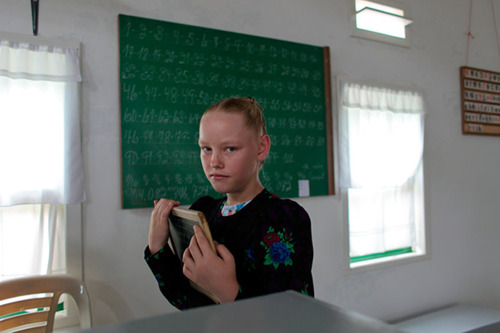


Similarly, in 2006 the Amish community of Nickel Mines, Penn. experienced a horrific school hostage situation and shooting, where 10 girls (aged 6-13) were shot, killing 5. Acts of violence are of course much more difficult for people, who have been so isolated from the rest of the world, to deal with. Are these communities 'wrong' to isolate themselves in this way, setting themselves up only to deal with the everyday and the simplistic? Or are they better off not knowing, what we know?
Photos by Lisa Wiltse
Friday, March 25, 2011
A man's world
Every day 7,000 female fetuses are aborted in India.
— U.N.
Male babies are often more desired than female babies. Why this is, I personally don't understand. But of course it all boils down to how sex and gender are valued by each society, culture and individual living in a specific space. Women are most often perceived as the 'weaker sex', this might be true in some cases, where physical strength is measured. But what about emotional toughness and other forms of strength? How far can physical strength really get you? It is also about gendering someone in a specific way. We are all gendered everyday by others and ourselves to act female or male. Prefering a boy over a girl ingrains binary stereotypes of what is to be considered male and what is female and widens the gap between the sexes and genders. This allows no space for gender fluidity, which leads to more discrimination and intolerance. Walter Astrada beautifully captures gender issues in India, in his reportage Undesired, where it is truly a man's world...

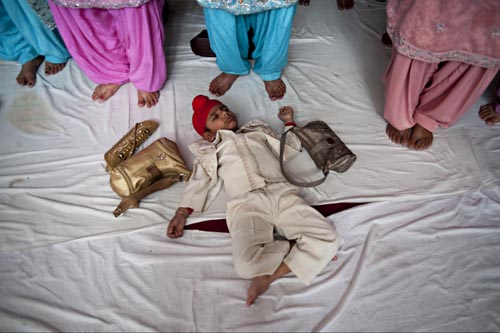

"Until the 1980s, when ultrasound machines became more widespread, girls were commonly killed at birth or were neglected of health and nutrition to ensure their death. Baby girls were often left to die in dumpsters, buried in clay pots or poisoned. This horrific measures are still happening daily. Across the country there is a 47 percent excess female child mortality, girls aged 1-to-4 who are dying before their life expectancy because of discrimination."


"The arrival of ultrasound machines, and its subsequent exploitation, ushered in a silent era of organized crime. Now able to identify the sex of a fetus early in pregnancy, parents who learn their child is a girl often abort her. The government has banned abortions based on gender for the last 16 years. Every ultrasound clinic is required to have a poster explaining the law, yet this $250 million business a year flourishes because of deeply entrenched traditions, official apathy and the lucrative business of illegal ultrasounds."(http://mediastorm.com/pub/projects/undesired)


For more visit:
http://www.reportage-bygettyimages.com/#p=features/Gender_Issues_in_India
Thursday, March 24, 2011
Not so green India
"We are now witnessing the beginning of the second Green Revolution in India. The Punjab in the north west of India was an experiment to test an oil based, chemically dependent, corporately controlled model. The land, the water and its inhabitants are now testament to a failed system. A system driven not by a desire to enhance an already sustainable system but to destroy it and replace it with one orientated around profit and plunder." - Jason Taylor, documetary filmmaker.


I thought this documentary on the 'Green revolution' in India was quite interesting:
Children in charge
Child-headed households have become a growing problem in South Africa and throughout the rest of Africa. Due to the prevalence of HIV/AIDS, children are expected to raise their siblings and run the household, when their parents die. Other causes that have led to child-headed households include natural disasters, war, and civil strife. This of course happens mostly in rural areas. Worry and responsibility for providing food is the most basic problem these children face among many.
The issue here is now that these children might fall into similar patterns most of their parents followed. When they stay home caring for their siblings, they drop out of school. Without any education and struggling to provide for the family, these girls and often boys, might engage in risky behaviour that might result in them contracting HIV/AIDS themselves. This then starts the cycle all over again.
Afripads

As a woman, ever thought what you'd do without sanitary products? In a country like Uganda, with limited resources, millions of teenage girls skip up to 20% of the school year.
Why?
Why?
Because they struggle to afford mainstream sanitary products, such as pads and tampons, when they menstruate. They are said to use newspaper, toilet paper and old clothing as a substitute. Their absenteeism from school has majorly affected the girls' studies and has hampered their academic potential. The solution? AFRIpads. This is a cheap, washable, environmentally-freindly, cloth pad. The pads have not only ensured that the girls attend school, but it's also empowering local women who manufacture these pads and at the same time boosts the local economy. These pads have also helped to enhance their health, since its much more sanitary than using other materials such as newspaper.
This really puts in perspective the kind of things we take for granted. Also think about local and how buying local can help benefit poor local communities. When you pick up a can of whole peeled tomatoes at the supermarket, there might be one for R6, 50 and one for R7, 98. The cheaper one is most likely from China and the more expensive one made locally. Think before you buy.
For more, visit: http://www.afripads.com/
Wednesday, March 23, 2011
Andrej Pejic: Gender bender

True gender bender, Andrej Pejic, made quite a splash when 'he' walked in Jean Paul Gaultier's autumn/winter 2011 show in Paris earlier this year. This model has confused many people, mainly because people can't figure him out. Is he a boy or a girl? Pejic told a Telegraph reporter that he "didn't plan any of this but if that's what it takes for me to have a career in this industry, then why not?" When asked if he'd consider getting a sex change, Pejic said, "Yes, if I was offered a Victoria's Secret contract. You'd have to, wouldn't you. I can't imagine doing it any other way. But, at this point I'm comfortable with who I am now."
Most of the world of course thinks in this binary way. There is always a need to define someone, man or women? black or white? attractive or ugly? There are such narrow definitions of what a man or a woman is. These stereotypes make it very difficult for those trying to break down this order.
Most of the world of course thinks in this binary way. There is always a need to define someone, man or women? black or white? attractive or ugly? There are such narrow definitions of what a man or a woman is. These stereotypes make it very difficult for those trying to break down this order.

Watch this video on Andrej's journey:
Subscribe to:
Posts (Atom)